Everyone Thinks They Know AI
It is a Tuesday evening in late autumn, and somewhere in a Cheshire kitchen a teenager is asking ChatGPT to find a pair of trainers in a colourway that sold out in minutes. Upstairs, her father is having Claude tidy up a firm but polite letter to a builder who has missed three deadlines. Her mother, meanwhile, has asked Gemini to design invitations for a seventh birthday party, complete with a unicorn in goalkeeping gloves.
Everyone in the house would say, with some justification, that they know AI. They use it most days. It is quick, clever and occasionally uncanny.
It is also, for the most part, a party trick. Each request begins from scratch, is answered, and is forgotten. The assistant knows nothing about the family it has just helped, and the family, sensibly, tells it very little.
The real change is not in asking better questions. It is in AI moving from something you occasionally open to something that runs quietly underneath the way you live: a private assistant that knows your commitments, your preferences and your people, and acts on your behalf within limits you set.
This is not a replacement for the team you already have. A good PA, agent or family office brings things no software can: judgement, discretion, relationships. What an always-on assistant offers them is a second pair of hands that never sleeps, never loses a thread and never needs the same thing explained twice. The humans set the strategy. The assistant does the chasing.
Consider the diary. For many readers of this magazine it is less a calendar than a logistics operation: training blocks, recovery, travel, match days, commercial shoots, charity appearances, and the school run that somehow has to fit around all of it. An assistant with access to every calendar in the household can spot the clash before anyone else does, propose the fix, and brief the driver, the nanny and the agent in one go.
Then there is shopping, which is quietly becoming one of the most practical uses of all. An assistant can now act as a personal shopper that genuinely knows you: your sizes across brands, the tailor you trust, the fact that you never wear yellow, the budget you would rather not discuss. It can reorder the protein, rebook the restaurant when the flight moves, return the jacket that arrived in the wrong fit, and ask before spending anything above the figure you have agreed. Retailers and payment companies are building for exactly this kind of delegated buying, though it is still early and best introduced gradually.
Security is where the stakes rise. An assistant connected to your cameras, gates and alarm can tell the difference between the gardener arriving on a Thursday and a car idling outside at two in the morning. It can manage who is let in and when, and alert the right person rather than everyone. Just as importantly, it can help control who knows where you will be, which for people whose movements have a market value is not a trivial matter.
And then the house itself. Lighting, heating, cameras, gates and pool are often run from half a dozen apps, each with its own login and its own idea of how things should work. A single assistant can sit above all of them, so that “we are leaving for the airport” means the heating drops, the lights settle into their away pattern, the cameras arm and the gates lock behind you. One point of command, one piece of kit.
The physical world is following. Many homes already have a robot mower on the lawn, a robot vacuum in the hallway and a cleaner working the pool. Individually they are useful; coordinated by one intelligence that knows the family is away, or that a party is planned for Saturday, they become something closer to staff. Further out, the first domestic humanoid robots are only now beginning to reach consumers, and they remain early, expensive and limited. They are the direction of travel rather than something to plan the household around. The point is not any single machine. It is that one capable hub coordinating many devices is worth far more than a drawer full of separate apps.
Which leaves the matter of where that hub should live.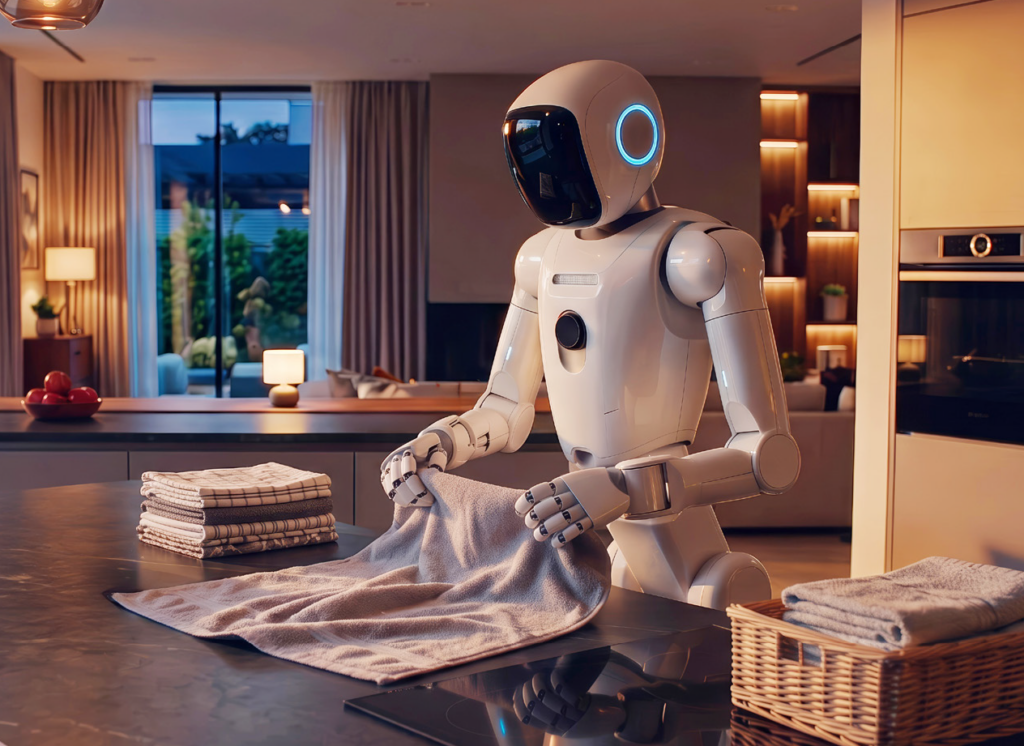
Most AI today runs on someone else’s computers, shared with millions of other users. For casual use that is perfectly sensible. For an assistant that holds your diary, your children’s timetables, the layout of your home and your spending habits, it deserves more thought. The alternative is to run the core of it on hardware you own, in your home or office, where you decide what it can see, what it can spend and what it remembers.
The advantages are practical. It is responsive and always on, not waiting its turn behind everyone else. Your most sensitive information stays on a machine you control rather than travelling to servers you will never see; no system is beyond attack, but the fewer places your data lives, the less exposed you are. And set against a steadily growing stack of monthly subscriptions, it is a single investment you own outright.
The best setups tend to be hybrid, calling on cloud services for particular jobs where that makes sense. What matters is that the brain, and the private information it relies on, sits with you.
Back in that Cheshire kitchen, the trainers, the letter and the invitations would all still get done. The difference is that nobody would need to ask. The assistant would already know the size, the builder’s history and the guest list, and it would have checked the diary before anyone thought to.
The people who get the most from AI will not be those with the cleverest apps. They will be the ones who treat it the way they treat a good accountant or a trusted security team: as infrastructure, chosen carefully and kept close.
Everyone thinks they know AI. The ones who own it will know it best.
Enquire today at [email protected]
Read More Articles